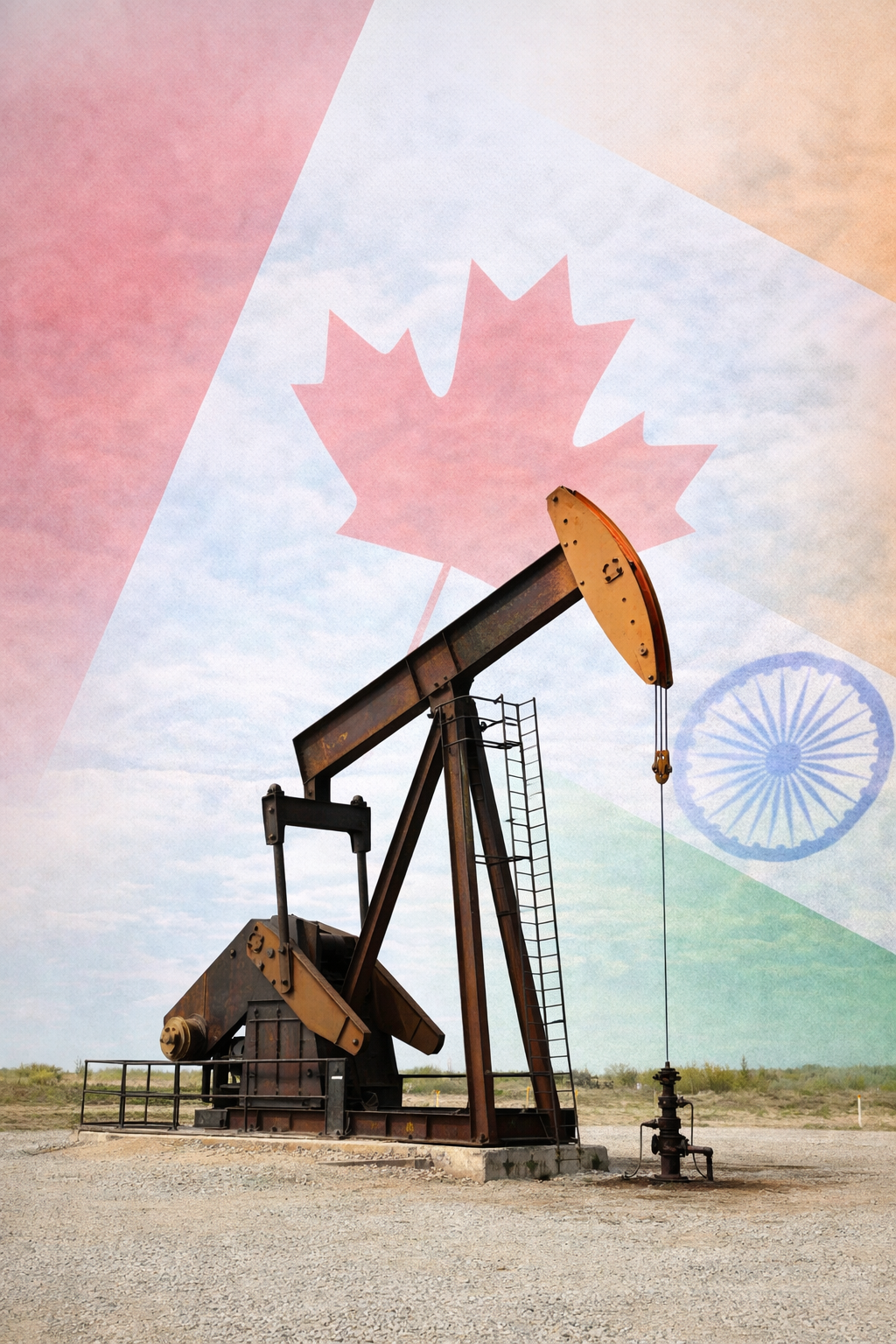
Having been an integral part of the Canada – India oil and gas and overall trade and investment corridor as a Trade Commissioner with the Government of Canada in New Delhi for 17 long years till 2024, the above question does come to my mind! While the first time presence of NRCan Minister Hodgson at India Energy Week (IEW) is true but we shouldn’t forget that NRCan Minister Joe Oliver had led an oil and gas sector delegation to Petrotech (IEW’s former version) India in October 2012. A lot was discussed then with the then Minister of Petroleum and Natural Gas (MoPNG) about strengthening Canada-India oil and gas and energy sector relationships. But the outcome?
Once again in 2014, after an 18 month long effort between stakeholders from both Canada and India to enhance LNG exports from Canada’s Eastern Coast to India and also to use the existing infrastructure from Western Canada to India for transfering LNG, Indian Oil Corporation Limited (IOCL) through its wholly owned affiliate IndOil Montney Ltd, Canada decided to buy 10% of Petronas’s share in Progress Energy Canada Ltd. to offtake its share of LNG from this project. The project for exports of LNG from Eastern Canada to India did not take-off due to lack of interest from investors and IndianOil’s co-shared project from Western Canada was put into a backburner due to environmental issues.
Just goes on to show that even if G2G intentions are clear to develop relations between two nations are strong, but trade and investments are links are all dependent on economics.
Nonetheless, the current circumstances are different from what it were perhaps a decade ago.
India (MoPNG) and Canada (NRCan) Sign Joint Statement on Energy Cooperation at India Energy Week 2026
27 JAN 2026 PIB Delhi
At the invitation of the Hon’ble Minister of Petroleum and Natural Gas of India, H.E. Shri Hardeep Singh Puri, the Hon’ble Minister of Energy and Natural Resources of Canada, H.E. Timothy Hodgson, participated in India Energy Week 2026 (IEW’26) in Goa, marking the first high-level participation of a Canadian Cabinet Minister at IEW. On the sidelines of the event, the two Ministers held a bilateral meeting and launched the renewed India-Canada Ministerial Energy Dialogue. During this meeting, the Ministers affirmed the immense importance that energy security and diversity of supply has in the safety, wellbeing, and economic vitality of both countries.
This meeting is a follow up to the direction provided by the Prime Minister(s) of India and Canada during their interaction on the sidelines of the G7 Summit, held in June 2025 in Kananaskis, Canada, wherein both leaders underscored the importance of restarting senior ministerial, as well as working-level engagements.
India’s Ministry of Petroleum and Natural Gas and Natural Resources Canada recognized the complementary nature of their energy sectors, and the mutual value to be gained on sustained engagement on energy matters. Canada has stated its goal of becoming an energy superpower in clean and conventional energy, with export diversification as a priority while India, as the epicenter of global energy landscape, offers a natural and symbiotic partnership grounded in scale, stability, and long-term opportunity. Canada has current and emerging liquefied natural gas (LNG) projects, is increasing production and exports of crude oil to markets in Asia via the Trans Mountain Expansion (TMX) Pipeline and is advancing liquefied petroleum gas (LPG) exports to Asia via the west coast of Canada. At the same time, India being the world’s third largest oil consumer, fourth largest LNG importer, third largest LPG consumer, and having fourth largest refining capacity, is projected to remain at the center of the global energy landscape, accounting for over one-third of the growth in global energy demand over the next two decades, largest contribution by any country. Even efforts are underway in India to substantially scale up domestic oil production, significantly expand refining capacity, increase use of natural gas in the energy mix. Thus, India and Canada have significant potential to emerge strong collaborators in area of energy fuels. In this context, the Ministers affirm to deepen bilateral energy trade including supply of Canadian LNG, LPG, and crude oil to India, and supply of refined petroleum products from India to Canada.
The Ministers recognize the importance of joint commercial and investment partnerships in each other’s energy sector. Canada is acting quickly to build energy projects and supply products to international markets, with Asia as a priority region. In 2025, the Government of Canada launched the Major Projects Office and announced the acceleration of several energy and resource projects and strategies, representing more than $116 billion in investments. India is also investing heavily in its own energy supply and prosperity. India highlighted the various policy reforms undertaken, including the huge investment opportunity of US$ 500 billion in overall value chain of energy sector. Recognizing this, the Ministers agreed to deepen long-term partnerships aimed at facilitating increased reciprocal investment in the Indian and Canadian energy sectors.
The Ministers also recognized the importance of climate-related objectives. This includes efforts to reduce emissions in conventional energy value chains, including through carbon capture utilization and storage, and support for the development and deployment of cleaner technologies as energy demand grows. Recognizing that there exists a huge potential for cooperation in clean energy value chains, the Ministers noted the opportunities for collaboration in renewable energy, including hydrogen, biofuels and sustainable aviation fuel; battery storage; critical minerals; clean technologies; electricity systems; energy supply chain resilience, and the application of artificial intelligence in the energy sector.
The Ministers noted the ongoing collaborative efforts to advance the global energy transition via the global development and deployment of biofuels through Global Biofuels Alliance (GBA), where Canada is an observer.
Building on the deliberations, both sides affirm:
The importance of energy security and diverse energy supply chains. India, as a major consumer and Canada as a safe, secure and reliable supplier, can act in partnership to deepen trade and ensure stable and secure energy supplies. India and Canada will collaborate to promote and strengthen cooperation across trade in the energy sector, including services.
Their commitment to continued Government-to-Government dialogue and cooperation, such as through the India-Canada Ministerial Energy Dialogue, and regular and ongoing expert collaboration.
The intention to work in partnership to support meaningful Business-to-Business, or Business-to-Government, collaboration across the value chain.
Their mutual intent to continue supporting work through bilateral and multilateral mechanisms, as well as with industry partners, to support climate- objectives, for the benefit of the global community.
Canada, India Pledge To Grow Oil, Petroleum Trade In Energy ResetMark Carney and Prime Minister Narendra Modi restarted talks in November toward a comprehensive economic partnership agreement.
Bloomberg, World News, Jan 27, 2026
Canada and India will pledge to expand trade in oil and gas as the countries reboot their relationship after a diplomatic chill.
Ottawa will commit to ship more crude oil, liquefied natural gas and liquefied petroleum gas to India, while New Delhi will send more refined petroleum products to Canada, following a meeting between Canadian Energy Minister Tim Hodgson and Petroleum and Natural Gas Minister Hardeep Singh Puri, according to a joint statement seen by Bloomberg News.
The ministers will meet at India Energy Week in Goa on Tuesday, using the event to relaunch a “ministerial energy dialogue.” The mechanism, once the main channel for energy cooperation between the two countries, fell dormant amid an explosive dispute over the killing of a Canadian Sikh activist.
The renewed push marks one of Prime Minister Mark Carney’s major efforts to diversify Canada’s export markets at a time of escalating trade tensions with the US. It also reflects his government’s shift toward pragmatic, economy-first diplomacy with major Asian partners.
Hodgson and Puri will also commit to facilitating greater reciprocal investment in each other’s energy sectors and to exploring collaboration in areas including hydrogen, biofuels, battery storage, critical minerals, electricity systems and the use of artificial intelligence in the energy industry, according to the statement.
The relaunch of the dialogue signals that both governments see untapped potential – and strategic value – in tightening an energy relationship that had been left to drift.
Carney is expected to visit India in the coming weeks as part of the reset. He and Prime Minister Narendra Modi restarted talks in November toward a comprehensive economic partnership agreement.
Two‑way goods trade between Canada and India hit C$13.3 billion ($9.7 billion) in 2024, and Ottawa sees far more room to grow – especially in energy. India accounts for just 1% of Canada’s critical minerals exports, a gap the government says underscores the scale of the opportunity. Canada began exporting LNG to Asia as of June 2025, and its LPG terminals have relatively short shipping routes to India.
The expansion of the Trans Mountain pipeline has opened a direct path for crude shipments to India, though most Canadian barrels headed there still move through the US Gulf Coast.
Carney’s India visit later this year will follow his recent trip to Beijing, where he and President Xi Jinping agreed to reduce tariff barriers – a move that spurred US President Donald Trump to threaten 100% tariffs on Canadian goods if Ottawa “makes a deal with China.” Carney has stressed Canada isn’t seeking a free trade agreement with the Asian giant.